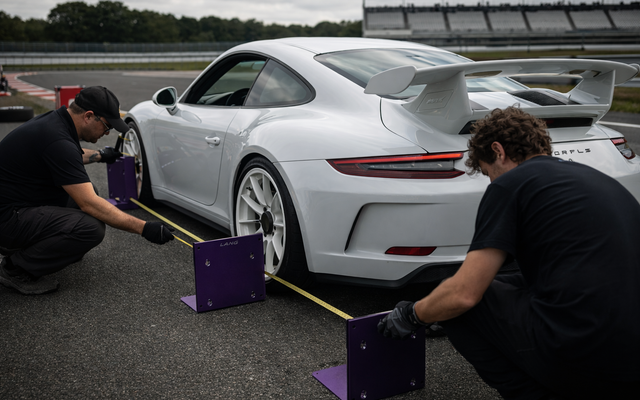
Within the intensely competitive arena of contemporary professional oversteer competition, podium finishes is not merely solely a product of raw torque or pilot bravado. Rather, it has become a intricate engineering challenge that necessitates a meticulous marriage of picking a proven vehicle platform, arming it with the highest-quality drift-spec parts, and, most essentially, understanding its dynamic performance on the course through advanced vehicle dynamics analysis tools. This definitive guide acts as your blueprint starting from the very first idea of a drift build right through to the last engineering-refined adjustments that transform a capable car into a predictable champion. We will examine in detail the art and science of vehicle alignment optimization, showing how a advanced suspension tuning tool like precise measurement hardware eliminates guesswork and provides unparalleled visibility into your car's actual behavior.
The cornerstone of any exceptional drift car is, indisputably, the base vehicle itself. A select group of platforms have attained renowned reputation within the global oversteer community due to their natural handling characteristics, robust build quality, and the immense availability of aftermarket parts available. Choosing the optimal car is the primary and most crucial choice a builder will make. As an example, the BMW's E36 3 Series is universally acknowledged as one of the best all-around cars for drifting of the modern era. Its excellent evenly distributed mass, alongside a RWD configuration and robust six-cylinder motors, establishes a chassis that is both easy to handle for novices and highly capable in the possession of a pro pilot. The successor of this concept, the E46 model BMW, improves on these attributes with a increasingly sophisticated structure, broader wheel track for improved high-speed stability, and still a greater degree of turning capability straight from the OEM. Another powerful contender in the top-level circuit is the C6 generation Corvette.
This V8-powered track weapon brings a distinctive array of strengths to the sideways world, such as a low-mass aluminium frame, a transaxle-style transaxle that aids in an perfect front-to-rear mass ratio, and the immense thrust of a large-displacement GM LS engine. This fusion makes it an complete force on track, able of starting and sustaining extended angles with apparently easy deployment of power. For those looking for outstanding bang-for-the-buck, the 350Z model Nissan stands out as a excellent example. It comes from the factory with a rigid body structure, a effective OEM limited-slip differential, and the free-revving V6 powerplant that provides sufficient performance for practicing and advancing in the discipline. Its successor, the Nissan 370Z, offers further advancements in chassis stiffness, suspension design, and peak powerplant output, cementing its position as a popular selection among professional pilots. Further iconic vehicles that warrant mention include the agile rotary-powered Mazda FC, the most popular Nissan S13, the American SN95 generation Mustang, the modern BMW E90, and the small yet incredibly fun and forgiving Mazda Miata. All of these chassis offers a different array of traits, challenges, and possibilities, but they all have in common the fundamental components required to be transformed into a capable sliding vehicle.
However, picking the right car is just the starting point. To access the true capability of any of these vehicles, significant upgrades to the steering and suspension systems are absolutely non-negotiable. This is where the domain of performance aftermarket parts comes into vital view. The one most game-changing upgrade for a purpose-built drift machine is the fitting of a drift-spec steering angle kit. These engineered systems, like those manufactured by performance brands like SLR, are engineered to dramatically expand the chassis's possible steering angle. A standard street car is severely restricted in how far its steering tires can rotate, a engineering limitation for public road use. In drifting, conversely, maximum countersteering is constantly needed to control and maintain a angle. An steering kit replaces the stock hubs, rod ends, and often control arms with pieces that enable the wheels to attain degrees of turn in excess of 70 or even 80 °, versus a typical OEM limit of around 40 to 50 °.
This immensely increased steering angle provides the driver with significantly enhanced command during a slide, making it far more straightforward to begin a drift, maintain it through a long bend, and change seamlessly from one angle to another. The improvement in handling is absolutely revolutionary. Paired with a appropriately chosen angle kit is the equally vital modification to the vehicle's suspension. Store-bought or even high-end street coilovers are simply not designed for the unique and extreme needs of competitive oversteer. A drift-spec system of suspension units is of utmost importance. These engineered suspension components have unique damping rates and spring stiffness that are tuned for the violent weight transfer that is characteristic of drifting. When a driver begins a angle, the chassis's mass is thrown forcefully to the outside of the turn. Correct performance suspension manage this transfer in a predictable manner, enabling the car to find its balance quickly and providing the operator accurate response through the steering wheel and seat. They furthermore provide accurate setting of stance, shock absorber rate, and weight balance, which are all integral aspects of dialing in the chassis's handling to a specific circuit or competition approach. In combination, a top-tier drift angle kit and a correctly selected pair of drift-spec coilovers constitute the undeniable hardware cornerstone upon which all future tuning is built.
Once the core components is in place, the subsequent essential phase in the project is the detailed adjustment of the car's wheel angles. This is the realm of chassis dynamics adjustment, a process that can appear overwhelmingly complex to the uninitiated but is, in fact, the defining factor to transforming a assembly of high-performance pieces into a cohesive and controllable whole. The most discussed aspect of tuning for sliding is undoubtedly negative camber. Wheel camber is the tilt of the rim compared to the perfectly straight line when viewed from the front-on of the car. When the top of the wheel is tilted towards the chassis, this is called negative camber. In drifting, inward-leaning wheels on the steering tires is universally used and is considered critical. The purpose is intrinsically tied to tire contact.
When a chassis is going around a bend at extreme sideways angles, the chassis tilts towards the outer of the turn. This body roll causes the outside front tire to reduce its ideal contact patch with the tarmac. By applying an inward tilt, the tire is pre-leaned to counteract this roll. As the chassis rolls into the bend, the tire gains a better contact patch with the track, maximizing its grip at the critical time when it is absolutely essential for directional command. Usually, front camber settings for a serious drift car vary from approximately -3 degrees to as high as -5 degrees or even greater, contingent on the details of the chassis configuration, rubber choice, and operator preference. The back wheels also use inward lean, but the angles are usually less and more nuanced than the front. Excessive camber at the back can result in the chassis excessively prone to oversteer and difficult to predict on power use, as it reduces the effective contact patch of the powered tires during linear power delivery. Hence, rear axle adjustments are often in the range of -1 degree to -3 degrees, finding a precise balance between giving sufficient cornering bite to help in entering and holding the slide while still maintaining effective hook-up for power-down the bend. Camber is just one part of the more complex suspension geometry equation, which also includes toe, caster angle, and bump steer adjustment.
Toe setting describes the orientation of the wheels when viewed from a bird's-eye view. Inward toe means the leading edges of the wheels are nearer together than the rear edges, while negative toe means the reverse. For oversteer, a small amount of front axle toe out is frequently employed to improve the initial response directional feel, making the car feel more nimble and ready to begin a oversteer moment. Rear axle toe angle is generally set to neutral or a very slight amount of toe-in to foster straight-line stability under acceleration. Caster is the forward or rearward tilt of the suspension pivot when looked at from the lateral of the vehicle. More positive caster enhances feedback and high-speed solidity, and it furthermore boosts camber gain during turning, which is extremely advantageous. Adjusting these settings is a detailed dance where a adjustment to a single parameter can and often will affect the others. The traditional method for tuning a vehicle's suspension geometry for sliding has historically been a tedious affair of experimentation and feeling. A driver or crew would introduce a modification based on experience, test the chassis on track, depend on the driver's subjective sensation and impressions, and then introduce another adjustment. This cycle would continue time after time until the vehicle felt "acceptable" or the available testing period ran out. This approach is not just extremely wasteful in terms of time and tires, fuel, and parts, but it is also inherently flawed.
Pilot feel is a infamously subjective data source, colored by many factors such as tiredness, varying track grip levels, temperature, and just the mindset of the operator on that particular run. What feels "loose" on one pass might feel "tight" on the subsequent lap, resulting in confusing information and frustrating changes. This traditional problem in chassis setup is specifically where contemporary telemetry systems has stepped in to transform the process.
The rise and application of advanced suspension tuning applications has ushered in a completely new paradigm for drift angle kits building and refining professional drift cars. These tools, showcased by innovative solutions like data acquisition tools, function by directly measuring the live physical movement of the chassis as it is operated on the course. In contrast to using subjective impression, these tools collect measurable data on essential parameters such as damper compression and extension, wheel speed, acceleration forces, steering angle, and driver input input. This collected information flow is then processed by powerful algorithms that can plot and interpret the data in a actionable manner. For the very first time, engineers and builders can observe specifically what the vehicle is exhibiting at any given point of a slide. This function changes the complete alignment optimization workflow. Think about the aforementioned task of setting the front negative camber for a given chassis. As an alternative to making a modification from -3 degrees to -3.5 degrees and then driving several passes to try and "feel" a change, a suspension tuning tool can deliver real-time and irrefutable data. The tool can display graphically how the suspension's grip is behaving during the most important phases of a angle: initiation, holding the angle, and switch. It can demonstrate if the existing camber setting is enabling the outside front tire to achieve optimal loading or if the tire is working inefficiently on its outer shoulder.
The system can subsequently make empirical advice for change. Perhaps the information shows that the outside front tire is still stressing its sidewall at -3.5 degrees of camber, indicating that a move towards inward lean, say -4 degrees, might be beneficial. Alternatively, the information might show that the tread is not coming up to heat or that the inner edge is wearing excessively, which could point to that there is excessive negative camber and a modest decrease back to -3.2 degrees would be more ideal. This level of accuracy and actionable intelligence was simply impossible in the era of exclusively mechanical adjustment.
The impact of using a comprehensive suspension tuning tool extends far beyond only dialing in camber. It functions as an essential suspension tuning guide that is tailored to your particular vehicle. When adjusting the shock absorber clickers on your suspension, rather than relying on general tips or copying another car's settings, you can use the data to see how the vehicle is behaving in reaction to your changes. The application can display the suspension travel data over a lap, highlighting if the dampers are controlling the body movement optimally or if they are causing the car to bounce too coilover setup tips much after a flick. It can aid in diagnosing issues like hitting the bump stops or losing droop, permitting you to introduce educated choices to helper springs, damping settings, or ride height. This approach extends equally to the complex task of suspension geometry optimization. Beyond camber, the tool can give data into how adjustments to toe and caster are impacting the car's balance during specific phases of a drift. For instance, it can assist you to determine the best amount of front toe-out for your individual steering geometry and driving style by measuring the quickness of initial response and the predictability drift suspension tuning guide of the chassis at lock countersteer. This makes the software an incredibly useful vehicle dynamics manual that is dynamically informed by the actual behavior of your specific car on the track. It elevates the entire process from a dark art into a repeatable development procedure.
Moreover, the application of a tool like data acquisition is in no way confined to professional engineers with large budgets. For the club-level enthusiast, it serves as an amazing force multiplier. It practically gives the builder with the analysis of a expert race engineer without needing the typical overhead. It drastically shortens the development time by delivering unambiguous answers to problems that would normally take seasons of trial and error to understand. A builder can learn how their particular car responds to specific inputs, gaining a deeper knowledge of car control in the endeavor. It additionally makes accessible high-level performance tuning concepts, permitting anyone with the drive to optimize their machine to achieve it in a systematic and productive fashion. This is especially valuable in a activity like drifting, where engineering knowledge has in the past been a closely guarded advantage among elite drivers. Today, that power can be in the hands of any dedicated builder.
In summary, the journey to engineering and optimizing the perfect championship-contending sliding vehicle is a comprehensive mission that perfectly integrates classic mechanical wisdom with revolutionary data solutions. It begins with the informed selection of a capable car, followed by the installation of non-negotiable competition hardware like drift-spec steering angle kits and expertly specified competition suspension units. The process then progresses into the precision stage of chassis dynamics adjustment, where settings like camber, toe setting, and caster are precisely adjusted to match the vehicle's modified capabilities and the operator's personal style. Ultimately, and what truly distinguishes the today's approach from the traditional methods, is the use of a advanced suspension tuning application. This platform eradicates the uncertainty and waste of purely feel-based adjustment by delivering quantifiable, real-time information on how the chassis is really performing. It functions as an unparalleled diagnostic aid, a comprehensive drift suspension tuning guide, and a master vehicle dynamics tool. Together, this complete approach ensures that all aspect of the drift car—from the pick of the car to the final tweak on the damper—is optimized for ultimate success on the circuit. It represents the full progression of the discipline of sliding, merging raw car control with precise suspension engineering to create the ultimate effective cars attainable.